

Founding Partner · Paris · United Kingdom · Africa · Asia
Bring the villa, land, access rights and any waterfront concession into the financing review. Then establish how the mortgage will fund the purchase and planned works.
At a glance
- Define
- The property, rights and obligations actually being acquired
- Check
- How much of the facility is available for completion
- For
- Overseas buyers seeking Lake Como financing from €1M
Can an overseas buyer obtain a mortgage for a Lake Como villa?
Mortgage routes can be explored for UK and US buyers acquiring property at Lake Como. The assessment covers the borrower and the security being offered. A high purchase price or a recognised address does not, by itself, establish the lender, loan amount or release timetable available to the transaction.
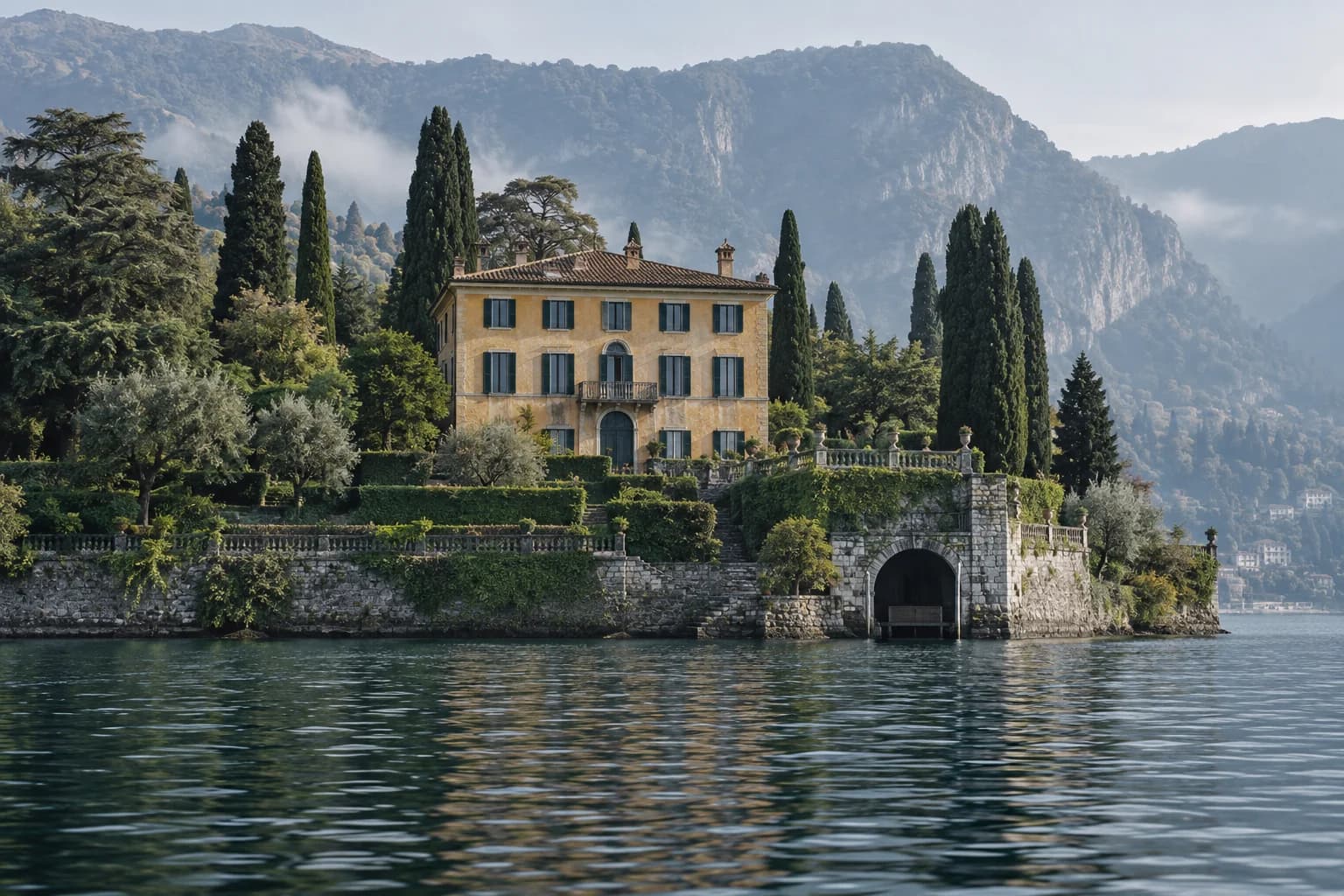
For a villa in Cernobbio, Laglio, Bellagio or Tremezzina, describe the actual home and intended use at the outset. Include any renovation, separate accommodation, shared access or advertised mooring. A bank needs to understand the property it is being asked to finance, alongside the buyer's income, assets and contribution.
BlueVectis works on financing requirements from €1M. At this level, preparation should produce a clear borrowing request and a schedule of unresolved matters. The aim is to establish whether the proposed acquisition can be financed on terms and dates that work for the buyer, before a contractual commitment depends on those assumptions.
Define what comes with the villa
Start with the deed, plans and property identifiers. Establish which buildings, land parcels, parking areas and ancillary spaces are included in the sale. A villa, a detached guest building and a garden across a lane may require different records. If the transaction includes several registered units or owners, make that visible in the summary sent to the bank.
Trace access from the public road to the house, garage and water. Ask the lawyer or notaio to identify the rights supporting any route across another owner's land and the obligations attached to shared areas. Ask the technical adviser to compare those rights with the route that exists on the ground. A gate being open during a viewing does not answer who is entitled to use it.
If buying an apartment within a converted villa, obtain the condominium rules, recent meeting records and information on charges and planned expenditure. Clarify which gardens, terraces, parking spaces and waterfront facilities are exclusive or shared. The mortgage file should describe the interest being acquired without treating communal amenities as separately owned property.
Connect each property question to evidence and a financing decision
The legal review, technical inspection and bank valuation have different purposes. The Notariat's checklist includes deeds, cadastral plans, building and habitability records, condominium material and existing-mortgage documentation. A local geometra, architect or engineer can investigate the physical property and relevant building history within their professional remit.
Use a short evidence schedule so that the advisers and bank see the same facts. Record the document received, its date, what it covers and any further action. If an issue is unresolved, describe it precisely. Neither a seller's assurance nor an unexplained caution should be turned into a conclusion about mortgage acceptance.
| Subject | Evidence or professional review | Question for the financing file |
|---|---|---|
| Villa, land and ancillary units | Deeds, registry/cadastral information and comparison with the actual property | What is being acquired and proposed as security? |
| Road, parking and shared access | Title rights, agreements and inspection of the route | Are the rights relied on documented, and are there costs or limits? |
| Dock, boathouse or mooring | Ownership or concession documents, permissions and authority confirmation where relevant | What right can the buyer obtain, for how long and on what conditions? |
| Protected status and alterations | Applicable designation, permissions and technical advice on the works | Can the proposed project proceed as described, and which approvals remain? |
| Condition and renovation | Survey, defined scope, costed schedule and lender release requirements | What must be funded before each bank draw becomes available? |
Check a dock concession separately from ownership of the house
An advertised private dock or mooring needs its own documentary review. Establish whether the arrangement involves owned property, a right over another property, or a concession to use public-domain land or water. The Lario authority administers lake-domain concessions and provides specific application and supporting-document routes. The description in the listing does not establish the legal arrangement.
Lombardia Regulation 9/2015, Article 28, provides an application process for replacing a concession holder, with conditions and exceptions; qualifying changes are completed through authorisation. Do not assume that signing the villa purchase automatically transfers every concession. Ask the authority and legal adviser which rules apply to the particular right and proposed transaction.
Obtain the current holder's documents, expiry date, charges, authorised structures and use, and any pending application or correspondence. If the acquisition depends on retaining a dock, have the contractual and funding consequences addressed early. The valuer and bank need the right that can actually be relied on, rather than an assumed permanent entitlement.
A useful illustration is a villa offered with a separate boathouse and a mooring described as available to the owner. That statement leaves several questions open: whether the boathouse is included in the title, what permits cover it, and whether the mooring is an allocated berth or another concession. Resolving those questions does not predetermine the value or the lending outcome.
Distinguish landscape controls from a villa's protected status
A property can raise landscape questions and separate cultural-property questions. Lombardia's SIBA mapping service is a useful starting point for identifying landscape protections. Ask the technical adviser to confirm the applicable documents and the procedure for the actual works. The region describes ordinary and simplified authorisation routes; do not assume that every repair, alteration or extension follows the same process.
For a villa described as historic or listed, obtain confirmation of its legal status. The Como and Lecco Soprintendenza provides a protection-status enquiry route and explains authorisation for work on protected cultural property. Age and marketing language alone do not establish the designation or the works permitted.
A qualifying cultural-property sale can also involve notification and public pre-emption rights. The local Soprintendenza explains the ordinary 60-day period and its extension to 180 days for late, missing or incomplete notification. Ask the notaio how the applicable process affects the transfer, payment and security, and agree the financing sequence with the bank. These rules do not apply to every home merely because it is near the lake.
For a proposed roof alteration, pool or internal reconfiguration, give the adviser a written scope and the permissions already obtained. Separate an architect's proposed design from an approved project. If the borrowing depends on completing the works, unresolved consent and timing belong in the credit discussion.
Give the valuer the property you intend to finance
The Bank of Italy explains that the lender assesses the borrower's income, assets and proposed collateral, with a valuation establishing the property's value for security purposes. The agreed purchase price and the bank's accepted value answer different questions. Establish the value basis and lending conditions for the actual request.
Give the valuer the same plans, rights and intended works described to the bank and notaio. If the sale includes more than one unit, a concession or a building whose use needs clarification, identify it expressly. Ask whether the assessment concerns the present property, a supported value after works, or both. Do not add an agent's projected renovation uplift to the valuation yourself.
If the report is lower than expected, distinguish a value difference from an unresolved security condition. A larger contribution may address the first while leaving the second unanswered. Ask for the outstanding requirements and review their cost and timing. No universal Lake Como discount can be inferred from a building's age, a steep site or a planning question.
For renovation finance, establish when the money is released
Prepare a works budget that includes the practical site conditions. Ask the project team to cost access for materials and contractors, temporary arrangements, structural work and any shared-property obligations. Separate the purchase price, required works, optional improvements and contingency. A broad refurbishment allowance gives the bank little basis for discussing releases.
Italian lenders offer structures using SAL, or stato avanzamento lavori: releases linked to progress of the works. Intesa Sanpaolo's Domus renovation page, for example, describes staged disbursement and checks by its appointed valuer. This illustrates the mechanism; it does not establish that this product, its advertised ratios or its pricing are available to a particular non-resident buyer.
Ask the proposed lender what it will release for the acquisition and what remains conditional on later progress. Compare those dates with the contractor's deposits and invoices. Establish the evidence needed, inspection process, final-release conditions and treatment of a delay or cost overrun. A facility can be approved while part of it remains unavailable for the seller's payment.
If you plan to fund the works yourself and refinance later, have the future application assessed as a separate uncertainty. Paying cash first does not guarantee a later loan or the same terms. The purchase should remain viable if the expected reimbursement is delayed or unavailable.
The same €2.2M facility can require different cash at completion
Consider a fictional €4M villa, €600,000 of works, a €90,000 works contingency and €350,000 of assumed acquisition and initial financing charges. The planned funding requirement is €5.04M. The €350,000 is a scenario allowance, not a tax calculation or fee quotation; ongoing interest, running costs and additional retained reserves are excluded.
Arrangement A provides €2.2M for the acquisition and leaves the buyer to fund all works. Arrangement B provides €1.9M for the acquisition and €300,000 through later works releases. Assume that these stated proceeds reach the transaction without further deductions and that all initial charges are already in the allowance. Neither arrangement is a lender offer.
Both use €2.2M of total borrowing and €2.84M of buyer resources for the stated budget. But Arrangement B requires €300,000 more buyer cash by completion. A €400,000 deposit already credited toward the price reduces the remaining completion cash in each column; it does not reduce the total contribution twice.
The later works contribution is an eventual total. If invoices fall due before the bank's inspections and releases, temporary cash needs can be higher. Obtain a dated schedule before relying on the second arrangement. Keep personal liquidity and any additional collateral commitment outside this project budget.
| Funding item | A: acquisition loan | B: acquisition plus later works |
|---|---|---|
| Total planned loan | €2,200,000 | €2,200,000 |
| Loan available for acquisition | €2,200,000 | €1,900,000 |
| Loan reserved for later works | €0 | €300,000 |
| Buyer cash for price and initial charges | €2,150,000 | €2,450,000 |
| Less deposit already credited | €400,000 | €400,000 |
| Remaining cash needed at completion | €1,750,000 | €2,050,000 |
| Eventual buyer funding for works and contingency | €690,000 | €390,000 |
| Total buyer resources for stated budget | €2,840,000 | €2,840,000 |
Present the overseas borrower and intended use clearly
The property review should progress alongside borrower eligibility. State nationality, residence, tax residence, employment or business income, existing debts, ownership proposal and source of contribution. Explain any planned move or retirement. The UK and US guides set out the relevant evidence in more detail.
For the contribution, identify amounts already liquid and amounts dependent on an investment sale or company distribution. Show which funds are held in euros and which require conversion. For ongoing payments, assess the currencies of income and debt together; a fixed euro payment can still have a changing sterling or dollar cost.
If letting is proposed, provide the intended operating arrangement and obtain local advice on permissions and obligations. Ask the lender whether it will consider rental receipts and what evidence it needs. Keep a budget that covers the period before the property can be used or let. An attractive holiday forecast does not establish accepted mortgage income.
Coordinate the purchase agreement, security and funds release
Have the notaio and legal adviser address the financing conditions and deadlines in the proposed commitment. Give them the actual borrowing request, including any reliance on later works funding or resolution of a property issue. An initial lender discussion should not be treated as a binding offer or protection for money paid to the seller.
The Bank of Italy notes that disbursement can follow signing once the mortgage security has been legally established. Confirm the sequence for the particular bank and sale. Any relevant protected-property process, concession authorisation or documentary correction should have a named owner and a realistic place in that timetable.
Compare the personalised loan terms, total costs, repayment schedule, insurance, security and any required asset relationship. A private-bank discussion still needs an acceptable property and release plan. Resolve these points before fixing travel or a signing date that depends on immediate availability of the entire facility.
Bring the actual Lake Como transaction to the financing review
BlueVectis prepares international mortgage cases, discusses them through suitable banking contacts and coordinates financing requirements through funds release. For Lake Como, the first submission should connect the buyer's financial position to the specific property, rights and works being proposed.
Share the listing, price, mortgage amount, purchase timetable and borrower profile. Add the documents available, intended use, renovation scope and any dock, access or protected-status question already identified. If a bank has declined or paused the case, provide its explanation and the evidence submitted.
A clearer presentation can help a lender assess complexity that an incomplete application leaves unanswered. Some issues can be resolved through documents or a revised request; others change feasibility. Approval remains the bank's decision. Our role is to prepare a credible case and make the next steps clear before the buyer relies on the financing.
Sources and further reading
- Bank of Italy: mortgages made easy
- Italian Notariat: property document checklist
- Lario authority: lake-domain concession documentation
- Lombardia Regulation 9/2015: Article 28
- Lombardia: SIBA landscape information
- Lombardia: landscape procedures
- SABAP Como and Lecco: protected property and transfers
- Intesa Sanpaolo: renovation mortgages and stage releases
This article provides general information, not personal mortgage, legal, tax or investment advice. Lending criteria and transaction requirements depend on the buyer, lender, property and jurisdiction.
Louis-Félix Salley
Louis-Félix spent ten years in private banking with Société Générale and Banque Transatlantique. He now advises international buyers on the financing and execution of prime residential acquisitions across France, Spain and Italy.